Signs (1969) for wind quintet and soundtracks
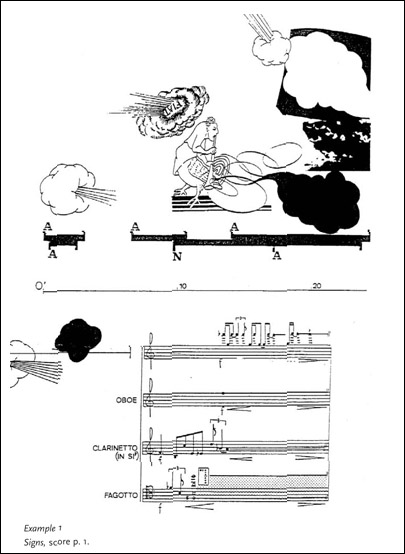
Performance: The players are positioned between two groups of loudspeakers, each placed approximately 3 yards away from the instrumentalists. Each player follows his part from a score. Since the sound material is derived entirely from the five wind instruments, including not only their characteristic quintet timbres but also the sounds made by their keys and valves, mouthpieces, the players' activities with/in their instruments, I decided to reproduce these complicated sounds, wich cannot be notated, visually with the collaboration of an artist to aid the quintet players in following their parts. It is therefore functional to project, if possible, the illustrated parts of the score, or the entire score of Signs during performance. The title Signs refers to the attraction exercised on people by toys for blowing audible signs. The possibilities of these instruments have been formed to a great extent both audibly and visually into new structures. Signs begins with the flute being warmed up by being blown straight into the mouthpiece. A journey through the pipes of the quintet ensues, a journey that ends at the mouthpiece, the energy of the reed set into vibration, then sudden silence. (score Signs, Donemus 1969) Signs consists of three movements, which proceed without pause. The first movement is subdivided into five fragments, which last two minutes. In this section, the ‘valve material’ on the tape plays an important role. The second movement is characterized by blowing. This section is directly connected with the techniques used in Bruynèl’s first wind quintet, Mécanique. Here, the tape plays a more or less soloistic role and the wind instruments continuously produce serious and dignified sounds. The second movement also has five fragments. The third and last movement is the largest and embodies the core of the composition. The ending is abrupt, a characteristic of other works by Bruynèl. Commissioned by the BUMA Cultural Fund. Dedicated to the Ardito Quintet. (from the Music Information Centre Donemus MuziekGroep Nederland)
visual score by Gérard Leonard van den Eerenbeemt
|